Maximum drawdown is the largest drop an account has made from a high point to a later low point, before a new high was set. It is given in money and as a percentage of that high: falling from $12,000 to $10,800 is a $1,200, or 10%, drawdown.
How is max drawdown calculated?
- Walk through the account value in time order, remembering the highest value seen so far — the peak.
- At each point, drawdown = peak − current value.
- The maximum drawdown is the largest of those, and its percentage is that amount ÷ the peak it was measured from.
Worked example
An account starts at $10,000, climbs to $12,000, falls to $10,800, then rises to $12,500, dips to $11,900 and ends at $13,000. The two drawdowns are $1,200 from $12,000 (10%) and $600 from $12,500 (4.8%). The maximum drawdown is $1,200, or 10%.
Balance drawdown or equity drawdown?
Balance only changes when a trade closes; equity also moves with the profit and loss of positions that are still open. A trade that went deep against you before recovering leaves no mark on the balance, but it did on equity. MetaTrader 5 does not keep a record of equity over time, so a drawdown worked out afterwards from account history is a balance drawdown — and the real equity low was usually deeper. Prop firm limits are often based on equity, so treat a balance figure as the floor, not the full picture.
How do deposits and withdrawals affect drawdown?
A withdrawal lowers the balance exactly like a loss, so it can create a drawdown that has nothing to do with trading. A deposit does the opposite and can hide one. Ignoring transfers altogether is worse, because then the percentages are measured against the wrong peak. The honest approach is to include them and say so whenever one falls inside a drawdown.
What is the recovery factor?
Net profit divided by the maximum drawdown. It answers how many times over the account earned back its worst fall: a recovery factor of 3 means the profit was three times the deepest drawdown.
Max drawdown in ApeX Journal
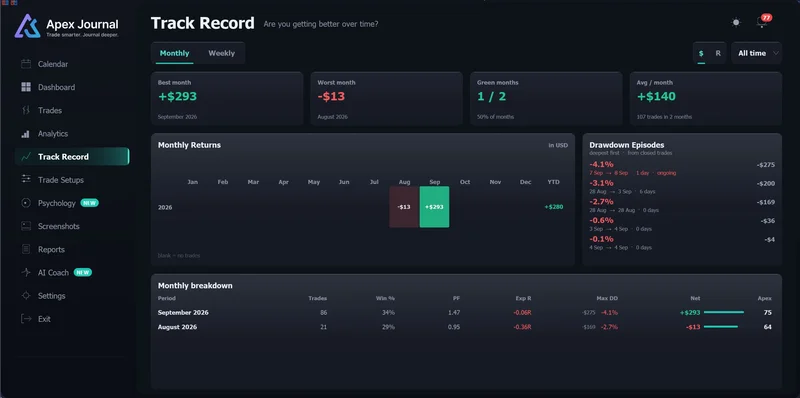
ApeX Journal measures drawdown on the balance, with deposits and withdrawals included and marked on the chart. The Dashboard shows the largest drawdown of the selected range in money and percent, shaded under the balance line. Reports measure each period's drawdown from the balance it started with, and Track Record lists your deepest drawdowns with how long each lasted, whether it is still open, and "incl. transfer" when money moved in or out during it. In the Apex Score radar, a recovery factor of 3 earns full marks.
Questions
What is an acceptable max drawdown?
It depends on the account rather than on a universal rule. A funded account may be closed at a fixed limit set by the firm, while a personal account is limited by how much you can sit through without changing your method mid-way. Whatever the figure, judge it next to the profit it came with — the recovery factor — and remember that a drawdown measured on balance understates the equity low.
Is max drawdown the same as a prop firm's daily loss limit?
No. Max drawdown is measured over the whole history from the highest peak, while a daily loss limit resets each day and is usually measured from that day's starting balance or equity. Each firm defines its own rule, so check theirs. To act on a limit as it happens, use a trade manager with a drawdown guard, such as Prop Guard in ApeX Trade Manager.
Why does my journal show a drawdown when I only withdrew money?
Because a withdrawal lowers the balance in the same way a loss does. A journal that counts transfers properly should label that drawdown as including a transfer, so you can tell it apart from a losing streak.