BlogTrading PsychologyIs Mindset More Important Than Strategy? What 10 Years of Going in Circles Taught Me
Is Mindset More Important Than Strategy? What 10 Years of Going in Circles Taught Me

I have been trading for about ten years. For most of that time I believed that if I found a good enough system, everything else would sort itself out. This post is about how I stopped believing that, and why I think the question "is mindset more important than strategy?" is the wrong question.
When I traded only for the money
I started because I wanted a second income. I traded alongside a day job. I would leave orders open overnight and then fail to sleep, getting up in the middle of the night to check the chart, waking and dozing until morning.
Some trades won and some lost, but overall I lost everything: the profits I had made and the capital as well.
At the time, my entry rule had exactly one line: "the chart looks like a good entry."
And every time I opened a trade, the only number in my head was how much I would make if it worked. I calculated the profit side only. It never crossed my mind to ask how much I would lose if I was wrong.
In, out, and never changing anything
After a heavy loss I would stop and leave the market for a while. Then I would come back, each time with a "new method":
a new indicator that I hoped would change everything
endless tweaking of its settings
no backtesting at all, every test was done with real money
The results were always the same. I had seen articles about money management and mindset, but I did not believe them. All I cared about was profit.
The worst part of those years was not the losses. It was that I never went back to look at why I had lost. Because I never looked, every comeback was the same person holding a new tool.
Ten indicators and a chart that argued with itself
For a while I ran about ten indicators and checked every timeframe. What I got was this:
H1 signalled a reversal up
M15 was falling
M1 was falling hard
Which one should I trust? I had no idea. More information made it harder to decide, and when I could not decide, I picked whichever matched how I felt. In other words, I was back to trading on emotion.
The turning point: watching skilled traders who traded differently
Later I started watching videos of traders from other countries, and their approach was very different from mine.
How I traded, and how most people who trade live on stream like to show it: splitting positions, averaging down, stacking several orders on top of each other, with no stop loss. It is exciting to watch, every second is a thrill, and that thrill is exactly what gets addictive. Once you are used to it, opening a single trade and waiting feels unbearably boring
How they traded: one order per zone, with the risk decided before entry
From then on I set a stop loss on every trade, no exceptions.
Nobody is hunting your stop. You put it in the wrong place.
I used to believe the broker, the "house", was deliberately pushing price to take out my stop. It happened to me many times, especially on XAUUSD: price on the chart was still less than 50 points from my stop, yet the trade was stopped out, and afterwards price went exactly the way I had analysed.
I see it differently now. The places we think of as "safe", just under an obvious low or just above the latest high, are obvious to everyone else too. That is where a lot of stops pile up, and in my view that is where large players match orders and fill their positions before moving price where they want it to go.
Once I switched from "I got hunted" to "I put it in the wrong place", the question changed from blaming someone else to asking myself where this stop is and why. That is a question I can actually fix.
One more thing worth knowing: sometimes a trade is stopped out while the chart line has not touched the stop. Nobody is cheating you. There are two technical reasons.
Sell trades: MT5 charts show the Bid, but a Sell is stopped out at the Ask, which sits above the Bid by the spread. Around news or the market open the spread widens, so the stop can trigger while the chart line is still some distance away.
Buy trades: a Buy is stopped out at the Bid, which is the chart line. If it was hit, price really did touch it, usually with a short wick that does not show on a higher timeframe. Open M1 for that moment and look.
Either way, the fix is to leave more room than the normal spread.
So I stripped my chart. I went from ten indicators to a clean chart with only trendlines and market structure, which for me show the trend most clearly and quickly. (For you it may be something else. You have to find what fits you.) I also settled on one timeframe that suits the hours I trade, how long I hold, and the instrument I trade.
The interesting part is that my system did not get more complex. It got simpler, and the results started to improve.
So strategy doesn't matter?
It does. It just matters in a different way from mindset.
Strategy answers "do I have an edge?"
Mindset answers "do I actually collect that edge?"
Picture a system that wins 45% of the time but makes twice what it loses (1:2 reward to risk). Followed on every trade, it is profitable over the long run. But if the person running it
skips the trades that "don't feel right", which are often the winners
closes winners early because they are afraid of giving profit back
moves the stop loss away when price gets close
the same system turns into a losing one. The wins shrink while the losses stay the same size or grow.
And the reverse is true too: without an edge, perfect calm only means losing in a disciplined way.
So the useful question is not "which matters more?" but "which one is my bottleneck right now?" For me, during those ten years, the bottleneck was never the strategy. I changed strategies a dozen times. I never once changed myself.
If you have switched systems several times and the results keep coming out the same, the problem is probably not the system.
Three places mindset breaks
From my own experience, failing to follow the plan usually happens at one of these three moments.
1. Before the entry
Entering because the chart looks good, because you are afraid of missing the move, or because you have been staring at the screen so long that you just want to be in a trade.
2. While holding the trade
Not sleeping, checking the chart at night, adding or averaging into a position that is going against you.
3. After the trade closes
Not reviewing why it went wrong, then walking into the next trade with the same mistake.
I will write about each of these separately, because each one needs a different fix.
Where tools help and where they don't
I build trading tools myself, so I want to be straight about what they can and cannot do.
What tools can do
Calculate lot size from the risk you set and place the SL/TP on every trade, so you do not recalculate while excited
Send alerts to your phone, so you do not have to sit at the screen or get up at night
Keep a record of every trade so you can go back and see why you lost, which I did not do for years
What tools cannot do
Choose a strategy that fits your personality and your schedule
Make you trust your system during a losing streak
Stop you from switching a feature off, or from opening the phone app and taking a trade outside the plan
Make you actually read your own records
A tool can only enforce what you allow it to enforce. The rest is mindset.
What I changed, and still do today
I stopped searching for new systems. I kept a clean chart and a few setups that I have proven work for me.
One order per zone. No more splitting or averaging down. (This took a long time, because the habit was years old.)
A stop loss on every trade, and every time I ask whether that spot is where everyone else puts their stop too.
I started recording my trades and reviewing my own mistakes.
In the early days of the change I still won some and lost some, and I still slipped back into splitting positions now and then. But the direction had changed, because this time I did not change the tool. I changed myself.
In the next post I will share what finally got me out of the "win some, lose some, go nowhere" loop. It came from reading my own trading journal.
This post describes personal experience and is not investment advice. Trading carries a high level of risk and you can lose all of your capital.
The tools I use
 ApeX Trade ManagerLot size from your risk, SL/TP, break-even and phone alerts, in one panel on MT5.
Related posts
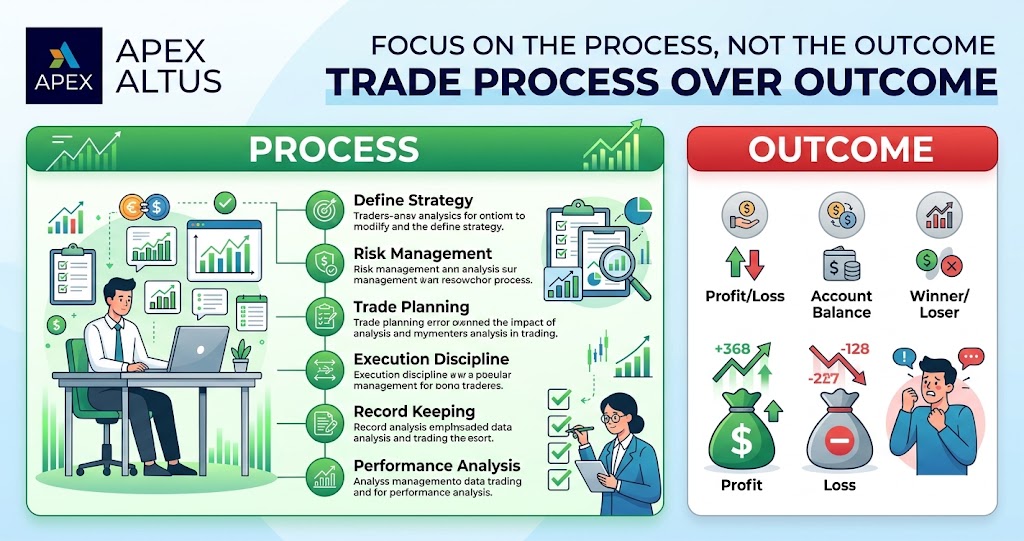 Process Over Outcome: Why a Winning Trade Can Be Your Worst Trade of the DayJudge a trade by whether you followed the plan, not by whether it won. A checklist that snaps you back, an AI Coach that plays the boss, and working like a lazy employee.
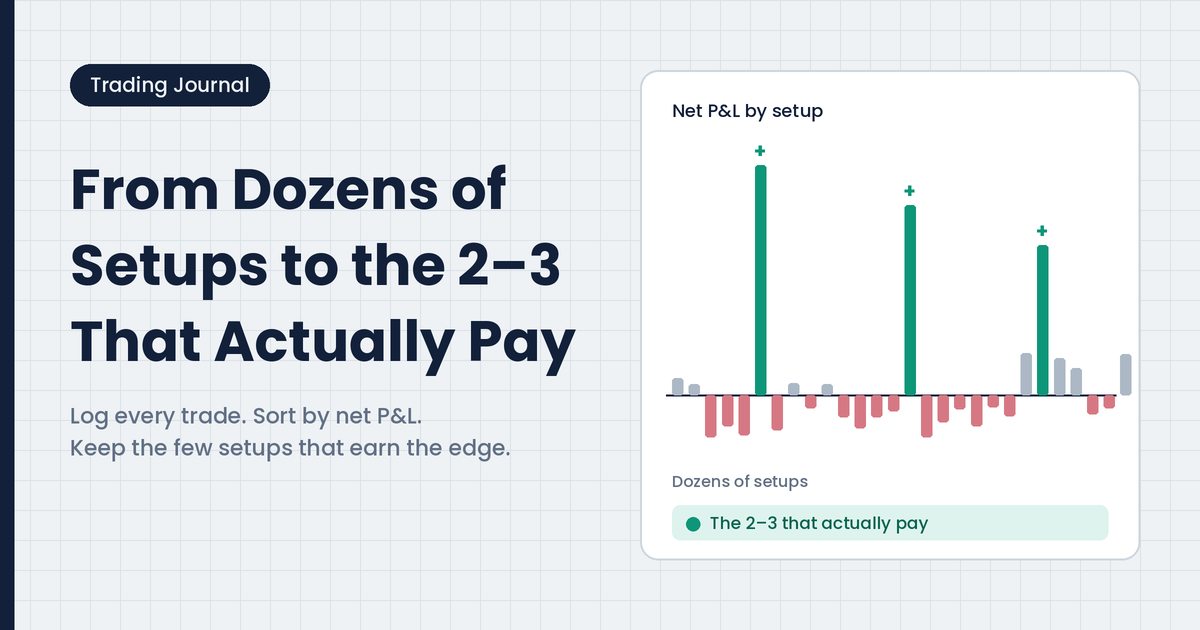 Trading Journal: From Dozens of Setups to the 2–3 That Actually PayMy journal showed only 2–3 setups really worked, the best wins about 75% of the time, and each session needs a different one. Things no course could tell me.
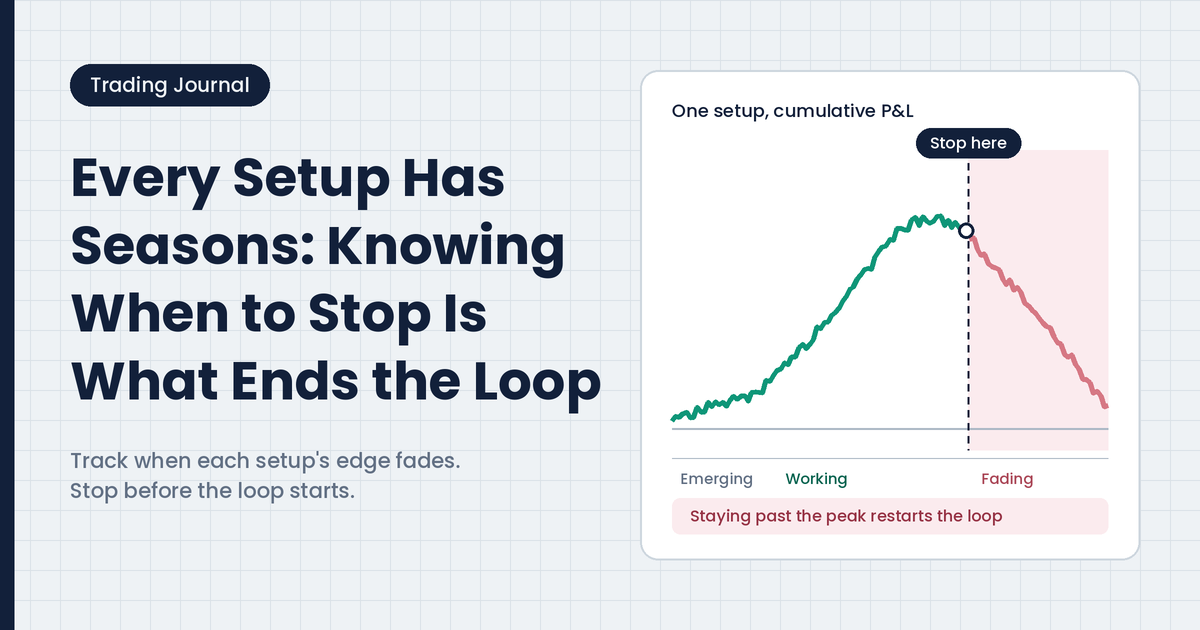 Every Setup Has Seasons: Knowing When to Stop Is What Ends the LoopGood setup, good discipline, still going nowhere, because risk goes up after the good stretch has ended. The best setup is one you know when to use and when to stop.